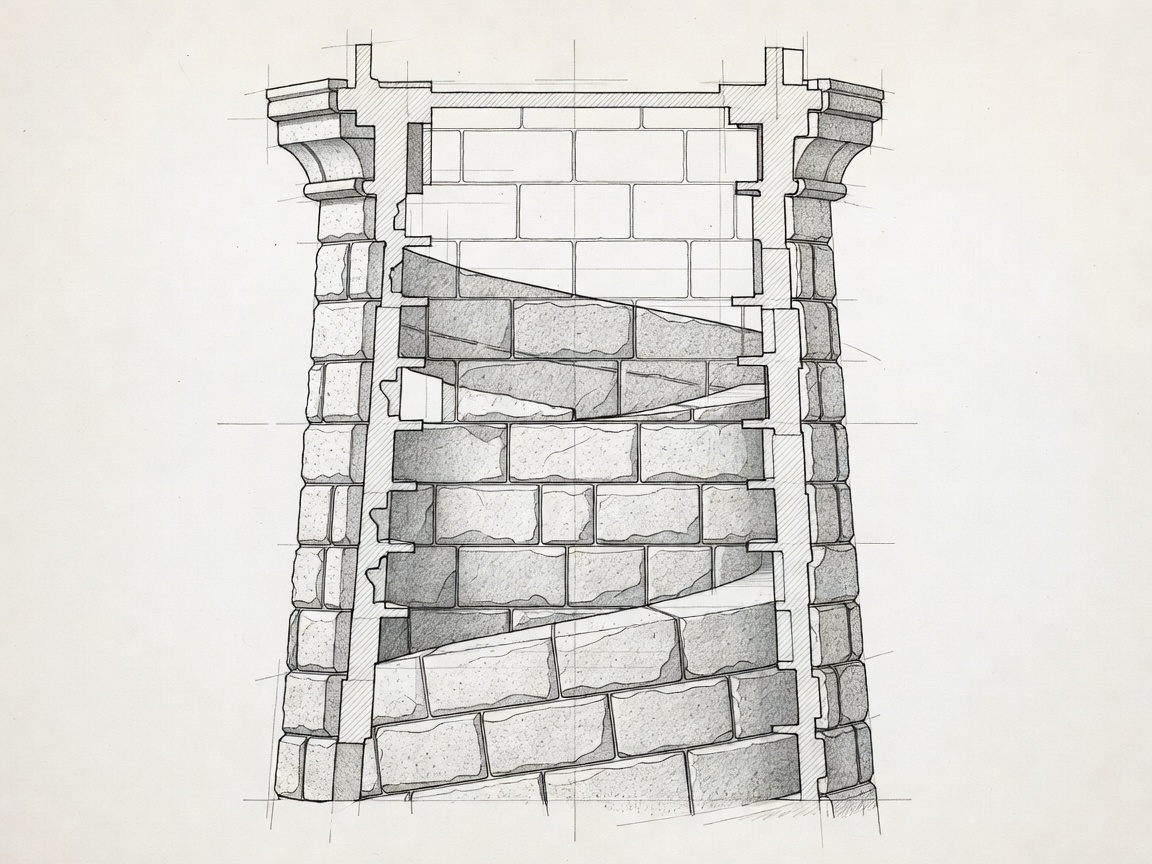
The Mechanics of Exposed Wave-Swept Towers
Offshore rock towers represent a distinct branch of civil engineering: structures where lateral hydrostatic impact exceeds vertical deadweight loads. The design evolution across Britain and Ireland stems from recurring structural failures on the Eddystone Reef off Plymouth Sound. Early timber octagons designed by Henry Winstanley and John Rudyard succumbed respectively to catastrophic storm wash and internal fire. John Smeaton shifted the paradigm in 1759 with his third Eddystone tower, introducing interlocking granite blocks and an outward curving profile modelled after an oak trunk.
Smeaton’s design was not purely aesthetic. The concave curve guides storm waves vertically upwards rather than taking the full direct impact on a sheer vertical wall. By forcing incoming breakers into a vertical curtain of spray, kinetic energy is dissipated into atmospheric lift rather than translated directly into shear stress against the lower bed joints. However, Robert Stevenson observed at Bell Rock that an exaggerated lower flare can inadvertently encourage breaking seas to ramp upward with severe velocity, occasionally striking the lantern deck glass. Stevenson subsequently modified the profile for the Bell Rock tower, raising the solid core foundation higher above high-water spring tides to dampen direct hydrodynamic shock.
Dovetail Interlocking and Shear Key Physics
Granite blocks in open reef lighthouses cannot rely on conventional lime mortar alone. Hydraulic action produces high vacuum and pressure pulses that dislodge unkeyed stone. Smeaton introduced horizontal and vertical dovetail tongues, locking adjacent voussoirs on every course. Each granite course forms a monolithic stone ring before the next course is lowered onto it.
Alan Stevenson refined this principle at Skerryvore Lighthouse between 1838 and 1844. Situated on an isolated gneiss reef southwest of Tiree, Skerryvore faces the uninterrupted fetch of the North Atlantic. Stevenson used hyperbolic curves calculated to resist estimated wave pressures of over 30 tonnes per square metre. The masonry utilizes horizontal and vertical keys, joggled joints, and Portland pozzolanic cement to resist washouts during setting cycles.
| Tower Installation | Masonry Mass / Height | Structural Core Profile | Primary Stone Composition |
|---|---|---|---|
| Eddystone (Smeaton) | 22 metres / Masonry tower | Parabolic outward base flare | Cornish granite exterior, limestone backing |
| Bell Rock (R. Stevenson) | 35 metres / 2,000+ tonnes | Solid base to 9m above spring tide | Mylnefield freestone interior, granite casing |
| Skerryvore (A. Stevenson) | 48 metres / 4,300+ tonnes | Hyperbolic solid core to 8m | Ross of Mull red granite |
| Fastnet Rock (W. Douglass) | 54 metres / 4,600+ tonnes | Solid granite core to 17.5m | Cornish granite interlocking joggles |
Fastnet Rock: The Pinnacle of Cornish Masonry
Completed in 1904 under William Douglass, engineer-in-chief to the Commissioners of Irish Lights, the Fastnet tower represents the absolute culmination of hand-dressed interlocking granite construction. The original cast-iron tower erected in 1854 proved prone to intense vibrational resonance during heavy winter gales. Inspection revealed the iron casing sustained significant flexure, risking shear bolt failure at the basal ring.
Douglass’s replacement tower consists of 2,074 granite blocks, carved with three-dimensional dovetail joggles on all six faces. No stone can be extracted without first dismantling every course above it. The lower courses form a completely solid cylindrical mass weighing over 2,000 tonnes, anchoring the structure directly into the argillaceous schist reef. This placement lowered the total center of gravity below the median wave strike point.
Comparative Analysis: Granite versus Cast Iron & Concrete
Engineers consistently weighed material durability against construction windows. While cast-iron towers offered rapid offshore erection during short tidal windows, they lacked the deadweight dampening required to resist repetitive high-frequency wave trains. Masonry gravity towers, although demanding multi-year dressed-stone assembly schedules, remain virtually impervious to coastal fatigue and structural deflection.