The Imperative for Distinct Photic Identity
During the 18th and early 19th centuries, the vast majority of lighthouses exhibited fixed white lights produced by open oil fires or stationary wick lamps. As coastal traffic multiplied along the English Channel, the Irish Sea, and the Firth of Forth, mariners encountered severe navigational ambiguity. In dense weather or gale-driven drift, mistaking one headland light for another led directly to groundings and vessel loss.
To establish unambiguous identities without depending on spoken or wireless communication, lighthouse authorities codified precise rhythmic cycles termed light characteristics. A light characteristic is an exact repeating sequence of illumination and darkness defined by strictly measured time intervals. These characteristics are compiled and published internationally in the Admiralty List of Lights and Fog Signals, enabling navigators to verify their position with nothing more than a marine chronometer or stopwatch.
Core Classification of Rhythmic Phases
International hydrographic standards govern five primary categories of continuous white or coloured light signals:
- Fixed (F): A continuous, steady light output. Rarely deployed today on primary outer towers due to confusion with background shore lighting.
- Flashing (Fl): The duration of light is distinctly shorter than the duration of darkness. Includes Group Flashing (e.g., Fl(2) 10s), where two short bursts occur in rapid succession followed by a prolonged dark interval.
- Occulting (Oc): The inverse of flashing: the total duration of light is longer than the duration of darkness. The beam remains illuminated, punctuated by crisp, timed eclipses.
- Isophase (Iso): Light and dark periods have exactly equal duration (e.g., 4s light, 4s dark).
- Quick (Q): Flashes repeated at a rate of 50 to 79 flashes per minute, alerting mariners to immediate navigational turning points or shoals.
| Station Profile | Authority Jurisdiction | Standard Characteristic | Nominal Optical Range |
|---|---|---|---|
| Fastnet Rock | Commissioners of Irish Lights | Fl W 5s (White flash every 5 seconds) | 27 Nautical Miles |
| Eddystone (Douglass) | Trinity House | Fl(2) W 10s (Two flashes every 10s) | 17 Nautical Miles |
| Bell Rock | Northern Lighthouse Board | Fl W 5s (Original: Alt W/R 60s) | 18 Nautical Miles |
| South Stack | Trinity House | Fl W 10s (White flash every 10 seconds) | 24 Nautical Miles |
Sector Lights: Spatial Geometry of Hazard Warning
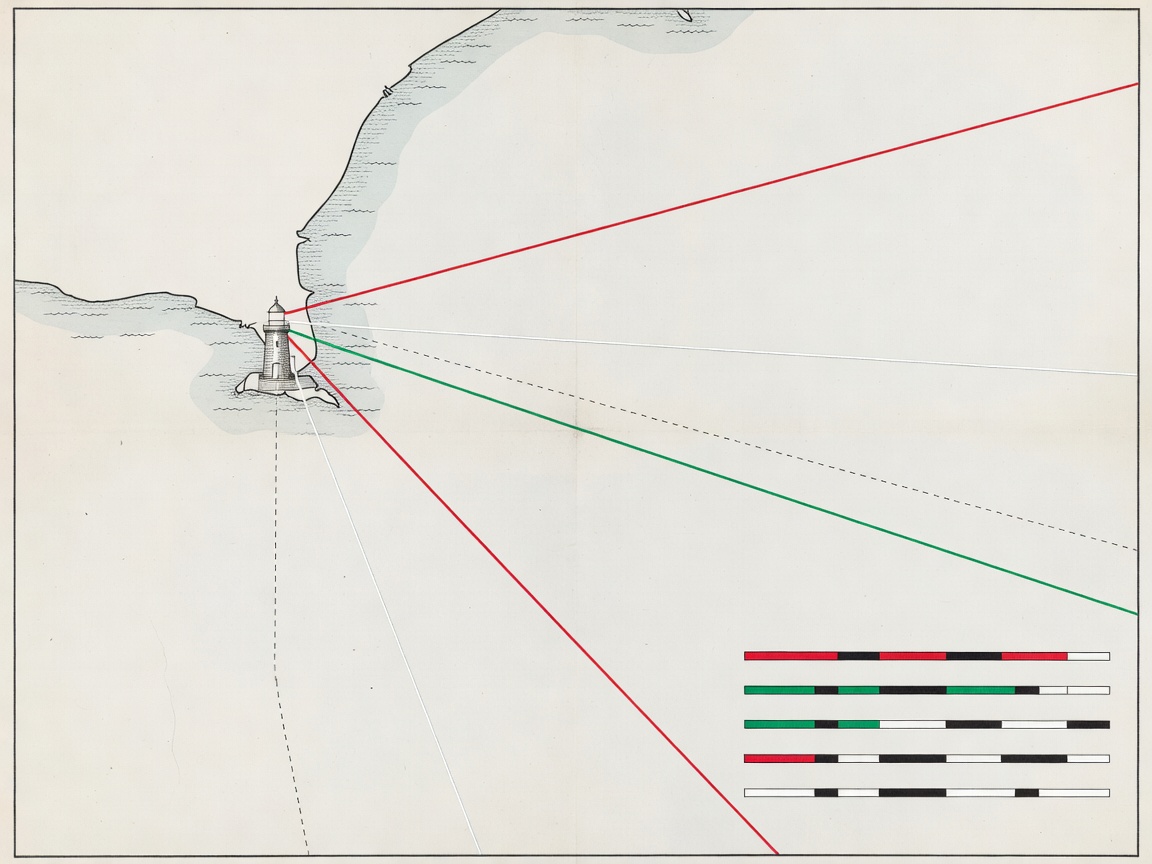
While flashing rhythms identify a tower’s identity, sector lights provide immediate spatial bearings regarding submerged obstacles. Sectoring involves inserting coloured glass panels (ruby red or emerald green) into specific arcs of the lantern room glass or optical frame.
A vessel approaching within safe, deep-water fairway coordinates observes a high-intensity white light. Should the vessel drift outside navigation limits toward an offshore sandbank, reef, or shallow ledge, the observed colour shifts instantaneously from white to red. Green sectors are frequently employed to delineate clear harbour channels or secondary anchorages. The precision of the transition zone between colours is critical: engineers demand sharp optical cut-offs, preventing broad ambiguous bands where red and white mix into pale orange.
Daymarks and Visual Station Signatures
Light signatures serve only during nightfall and conditions of reduced visibility. For daylight recognition, lighthouse towers function as daymarks. Authorities apply distinct high-contrast paint regimes: broad horizontal red-and-white bands (such as Beachy Head), black-and-white helical spirals, or leaving the dressed Cornish or Scottish granite exposed in its raw, natural hue to contrast against coastal cliff chalk and greensand.