The Intertidal Challenge
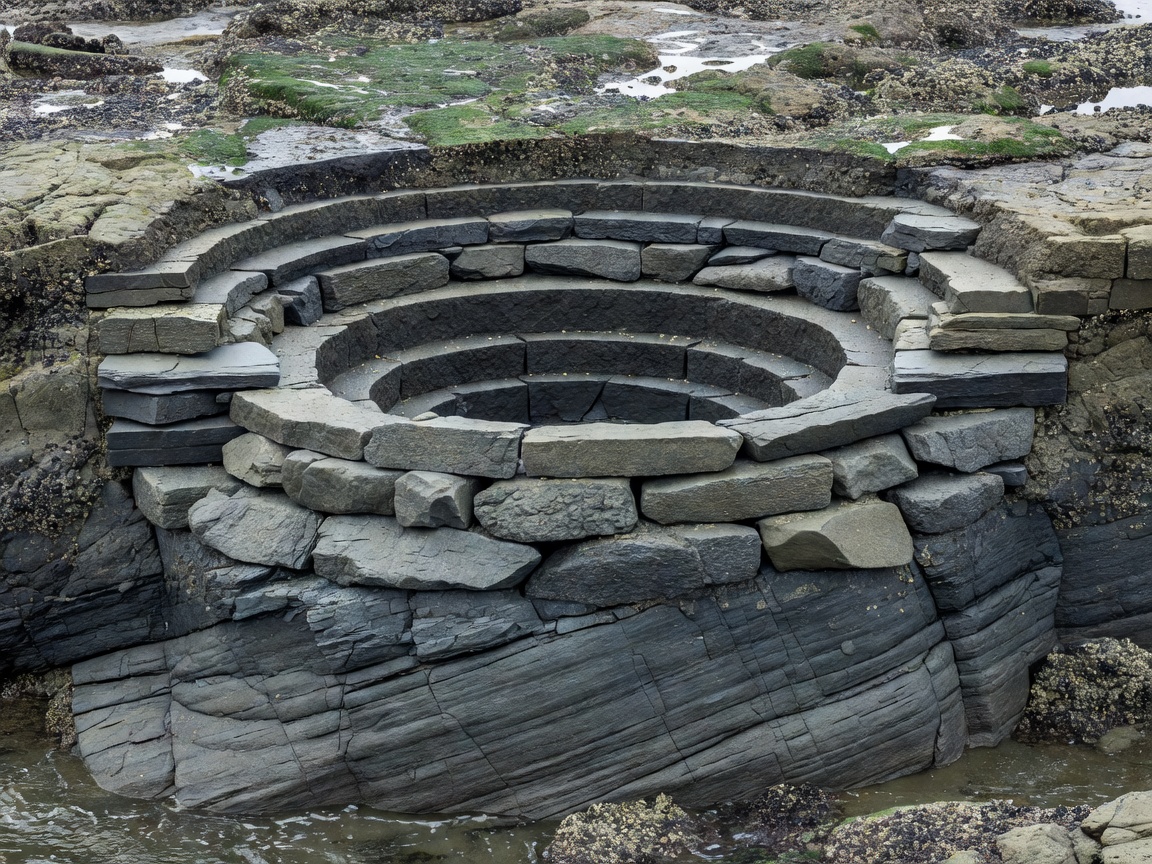
The primary point of physical failure for any wave-swept rock lighthouse lies at the intersection between the masonry base and the living reef. If sea water penetrates the bed joint beneath the first course, hydraulic ram action will exert uplifting forces measured in thousands of kilonewtons per square metre during gale conditions. Consequently, early engineers could not simply erect walls on natural bedrock; they had to carve horizontal circular sockets directly into the reef mass.
At Bell Rock, situated 11 miles into the North Sea off Arbroath, Robert Stevenson confronted an intertidal reef submerged under 4 metres of seawater at high tide. The exposed working window during neap tides was often restricted to fewer than two hours per shift. Stevenson’s quarrymen cut into the hard Old Red Sandstone using picks, chisels, and controlled gunpowder blasting, excavating a perfectly level circular pit over 13 metres in diameter. Every perimeter stone of the bottom course was recessed at least 300 millimetres into solid rock, preventing breaking waves from finding an exposed lateral edge to strip away.
Bedrock Geological Diversity Across Regions
Geological conditions varied drastically across the British and Irish coasts, dictating disparate foundation strategies:
- Eddystone Reef: Gneissose rock fractured with severe dip angles and fissures. Smeaton stepped the foundation pit in terraces to accommodate the natural strata rather than blasting an entirely level plain, which would have weakened surrounding bedrock integrity.
- Skerryvore: Igneous gneiss of extreme hardness. Blasting repeatedly dulled forged steel drills. Stevenson spent two full seasons simply levelling the rock face before the first granite block could be set.
- South Stack (Anglesey): Precambrian metamorphic schists subject to severe weathering and coastal cliff slipway dynamics, requiring deep vertical doweled anchor bolts into the underlying headland mass.
- Fastnet Rock: Highly cleaved Devonian slate and sandstone ribbons exposed to full Atlantic swell. William Douglass cut deep circular trenches and keyed every stone with pure neat Portland cement slurries to seal every internal rift.
| Station Location | Reef Lithology | Tidal Submergence | Basal Socketing Strategy |
|---|---|---|---|
| Bell Rock | Old Red Sandstone | Completely submerged at HT | 13.4m stepped pit cut into sandstone |
| Eddystone (Smeaton) | Gneiss / Metamorphic | Partially submerged at HWST | Horizontal stepped benching |
| Eddystone (Douglass) | Gneiss / Hornblende | Submerged lower reef shelf | Massive cylindrical granite base buffer |
| Skerryvore | Precambrian Gneiss | Exposed reef pinnacle | Level flat circle cut via hand chiselling |
Cofferdams, Caissons, and Tidal Windows
Where wave run-up prevented direct manual dressing, temporary timber and iron cofferdams were anchored into the stone with lead-run bolts. These cofferdams kept wave surge from washing out fresh hydraulic cement before chemical curing could occur.
John Smeaton experimented with quick-setting Roman cement and blue lias lime combined with pozzolanic ash from Civitavecchia, Italy. This formulation possessed the critical property of hydraulic hardening: setting underwater through chemical hydration rather than atmospheric carbonation. By the late 19th century, James Douglass and William Douglass relied entirely on early British Portland cements, which provided tensile bond strengths exceeding the shear strength of the native reef rock itself.
Bedrock Erosion and Relocation: Smeaton’s Tower
Even an indestructible masonry tower remains vulnerable to the deterioration of its supporting natural geology. By 1877, Smeaton’s Eddystone tower stood structurally sound after 120 years, but the gneiss reef underneath had developed severe micro-fractures caused by continuous wave impact. The rock shook perceptibly under heavy seas. Sir James Douglass was commissioned to design the fourth Eddystone tower on a adjacent, sturdier reef spur, dismantling the upper half of Smeaton’s historic tower and rebuilding it on Plymouth Hoe as a permanent public monument.